
Saba Digital Marketing

Should You Go User-Focused or SEO-Focused?

Some online marketing companies make the mistake of publishing SEO-focused content that is stuffed with keywords or otherwise unreadable. Usually, they just publish whatever content they can, sometimes duplication content, or publish content without thinking about what the user really wants. This is the wrong way to make content marketing work for you. Instead, focus on a user-oriented strategy with elements of SEO woven through.

Know Your Audience

First and foremost, you have to know who your audience is and who your potential customers are. The more you know about them and understand what drives them, the better you will be at creating content that attracts them and entices them to move forward in the buying process. Look at all the data you have and write detailed personas for your ideal customer. Then rely on these personas to write strong and effective content.

Think About What They Need

The best written content won’t make any difference if it does not address your target audience’s needs. Keep in mind that their needs might not always be directly linked with your product or service. Sometimes, these needs are more general and addressing them brings potential customers into the fold.

Know What You Want to Accomplish

With content marketing, you must be very clear on what you are trying to achieve. Are you hoping to increase your sales? Maybe you just want to increase your readership. Your goal will shape the content you create and how you approach your readers. Knowing what you are trying to do will help you decide how to do it.

Use SEO

Once you’ve implemented the user part of your strategy, it is time for the SEO strategy portion. This means writing thoughtful, interesting and shareable content that is optimized for search engines. Make use of metadata, alt tags on any images and linking to other pages on your site within blogs.

Find out about other effective ways to optimize website traffic for your business by calling Saba SEO at (858) 277-1717. Our SEO experts in San Diego are always available to take your call and schedule a free consultation.
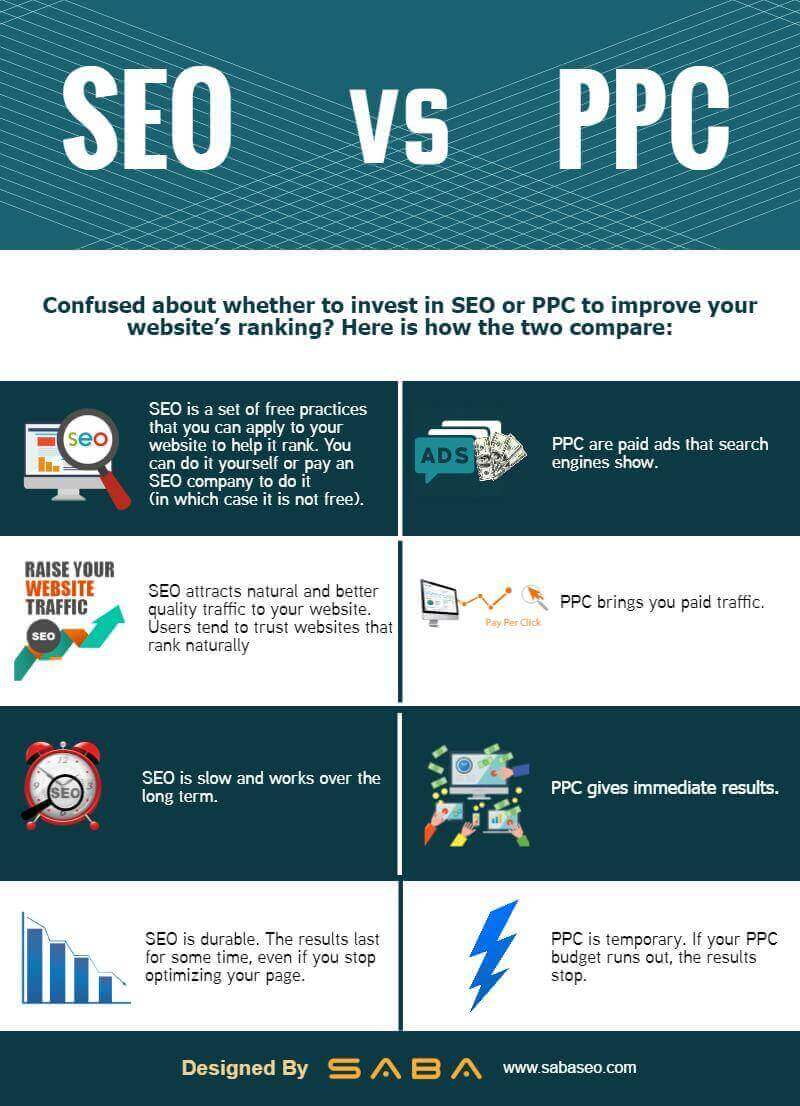

SEO Vs PPC [Infographic]

There are many ways to increase website traffic for your business these days, two of which are known as search engine optimization (SEO) or pay per click (PPC) marketing. If you’re trying to decide which method would work best for you, it’s important to consider the pros and cons of each.

Luckily, the SEO experts from Saba SEO are here to explain them. Read the infographic below to determine which form of online marketing would best suit your company.

SEO VS PPC

The Top 5 SEO Factors for Local Searches

If you want your business to be the first thing people find in Google, you need to refine your SEO strategy. Following are the top five SEO factors for local searches.

1. Claim Google My Business Page

Start by claiming your Google My Business page and plugging in all the important details for your business. These include:
– A long and unique description of your business with links
– Choosing the right categories for your business
– Adding your correct address and phone number
– Uploading photos
– Including your working hours if applicable

2. Get Local Reviews

Any local reviews will have a direct effect on your local ranking. Many people think this means just Google reviews, but it is actually any reviews on sites like Yelp or other online directories. Existing customers may be willing to comment about your business. Make it as easy as possible for people to leave a review.

3. Use Local Keywords on One Page

Optimizing your website for local SEO strategies is fairly simple and will go a long way to helping your rank. Basics include:
– An H1 tag with your relevant keyword plus the city and state or region
– A title tag with your relevant keyword plus the city and state or region
– A URL with your relevant keyword plus the city and state or region
– Content that includes your relevant keyword plus the city and state or region

4. Citations

Citations on online directories don’t even need to be linked to your page. The boost comes from your name, address, and phone number being listed correctly across the Internet. There are a handful of tools out there that can help you find current listing to check if they are updated and create new ones.

5. Click Through Rate

The click through rate, or CTR, is one of the core measurements for a website’s quality score and can help increase your page rank when your website consistently has a high click through rate.

Learn more about ways to boost your Google ranking and market your company by calling Saba SEO in San Diego at (858) 277-1717. Our experienced marketing and SEO experts will help you find the right strategy for your business.

3 Tips to Get Your Website to Appear in Competitive Searches

There is a great deal of competition on the Internet, and many businesses are having a tough time getting their websites to rank high on Google. However, there are a few simple tips any company can follow to improve their SEO strategy.

1. Publish Fresh and Relevant Content

When it comes to ranking on the search engine results pages, the number one thing you can do is publish fresh, relevant content on a regular basis. High-quality content written and published for your target audience will drive traffic and in turn improve your ranking. When creating content, it is also important to highlight keywords in every post that fit naturally within the content. For instance, a San Diego SEO company might write a post about getting a website to appear in competitive searches and highlight the keyword “SEO in San Diego.” Updating content regularly also tells the search engine your site is relevant and therefore deserves a good rank.

2. Use Metadata

When designing your site, make sure you utilize metadata. If you have already made your site, it is not too late to hire a trusted San Diego web development company to review or implement metadata, which includes:

  • Title meta tag – This is the title displayed at the top of the page. It is also arguably the most important piece of metadata because it tells the reader and search engine what the whole page is about.
  • Keywords – These are the most common words and phrases someone might search that would be relevant to your page. However, listing too many might do more harm than good. Choose roughly 3 to 4 keywords between 1 and 4 words each.
  • Description – This is the portion of text that will actually show in a browser when someone conducts a search. It should tell the reader what the page is about in an interesting way.

3. Get Backlinks

Arguably, backlinks are the most helpful thing for getting a good rank. Reputable backlinks to your site tell search engines like Google that your website is credible and relevant. As long as the links are from quality sources, the more links the better.

If you want your company’s website to appear in competitive searches, Saba SEO can help. Give us a call at 858-951-1717 and we can develop a strategy to give your site a more competitive edge and get it ranking higher. We hope to hear from you soon.

Why User Reviews Are Important for Local SEO

New studies show 9 out of 10 consumers read reviews before making a purchase or visiting a business and almost 75 percent of consumers will only move forward if they read a positive review. Most people know online reviews can affect business, but not everyone knows they can also affect local search results. Saba SEO, an SEO company San Diego businesses trust, examines a few of the ways customer reviews impact local SEO.

Local Reviews Create Unique Content

Local reviews are a great way for your business to generate unique, fresh content. It packs an added punch if the reviews are good, which encourages readers to visit your site. This user-generated content is more influential, and users typically hit on the long tail keywords your target audience would use when searching for your product. Reviews help you attract a target audience that is more likely to take action.

Google Likes Highly Rated Sites

Along with other local factors, such your business name, phone, and address, Google prefers sites with reviews. Google rewards favorable reviews with a better position in the rankings because they give your business credibility and authority.

Reviews Are Proof

Reviews are essentially social proof that people do (or don’t) like your company or product. Most people need reassurance before making a purchasing decision, and user-generated reviews are often one of the best sources for consumers. For instance, if two restaurants show up in a Google search, but one has 3 stars and 500 reviews and one has 4.5 stars and 300 reviews, the one with more stars is still likely to be chosen over the one with more reviews and a poorer score.

Other Review Sites Hold Weight

Reviews on Google are not the only ones that count. Customer reviews on sites like Yelp, TripAdvisor, and OpenTable can also impact local SEO. Having positive reviews on all these sites can help your business dominate the search results.

To learn more about the importance of local SEO and other aspects of search engine optimization, get in touch with Saba SEO at 858-951-1717. We are a leading provider of San Diego PPC management services and many other crucial SEO services. Get in touch with us today to find out the many ways we can help your company grow.

5 Tips for Getting SEM Right

Don’t underestimate the power of a well-planned search engine marketing strategy. Below we’ve outlined five effective tips to perfecting SEM for your company.

1. Use Schema Markup

If you are not already using schema markup, you are doing your business a disservice. Schema markup tells search engines what your content is about and how to display it in the results. This gives you more control regarding how your ads appear and can make them feel more personal.

2. Use Click-to-Call Ads

With more and more consumers using their mobile phones to find information, it’s more important than ever to use click-to-call ads. A customer who clicks on your ad should be able to reach the company or a customer service rep just by clicking on your landing page. No one wants to fill out lengthy contact forms on a handheld device.

3. Write Great Copy

This tip really goes back to basics. For many consumers, the difference in choosing one competitor over another comes down to the copy. You will not be able to separate your company from all the rest if you have the same stale headlines and trite ad copy. Always write great copy that drives home what makes your business and service different from everyone else’s. This includes writing a call to action that really makes people want more.

4. Use Ad Extensions

Ad extensions are just what they sound like. They extend the space of your ad so you can say more while simultaneously taking up more room on the page (and therefore pushing competitors further down the page). These extensions can actually double the size of your ad and include things like links to your product, service or a free quote. It can also show your physical location and contact information.

5. Use A/B Testing

Although A/B testing can seem daunting, it is the only way to really know what works and what doesn’t. Your ads may be converting, but there is always a chance they could be converting way more customers with a better headline, different language, or links included.

Need more tips to draw attention to your website? Turn to Saba SEO, the leading digital marketing agency in San Diego. Call (858) 277-1717 today to get a free quote.

Top 5 Tips for Videos to Increase Your SEO Rankings

Having trouble boosting your SEO rankings? No problem. In the digital age, there’s nothing more that potential customers love more than online videos. Here are five ways you can use videos to increase your SEO rankings.

1. Use Videos to Solve a Problem

One of the easiest ways to use professional video production to boost your search engine optimization efforts is to post videos that solve a common problem among your customers. This can be as simple as walking through the steps with customers, drawing on a whiteboard in a conference room or showing them how to troubleshoot software. You can also highlight products, display new innovative ways to use current product or release new product information.

2. Make a Video Resource Center

As you start making more and more videos, put together a video resource center that is easy for your customers to navigate. This should also be searchable, so make sure your videos are accurately labeled and tagged. There should also be a separate page for each video. Nothing is harder than trying to find the video you need when you are faced with an entire page of video content.

3. Transcriptions Can Help Rankings

It is a good idea to use transcriptions along with your video content. In fact, transcriptions will really help your organic search engine rankings. Include a transcription of the video directly to the page HTML. This gives viewers the option to read about the video if they cannot listen the whole time or to read through certain key points made in the video. Not only does this help your SEO efforts, it will help improve your user experience.

4. Use YouTube

YouTube is a great place to preview your high-value content and drive curious consumers back to your actual website. Leverage YouTube as an awareness channel and use the site’s annotations to put a call to action in the video that sends viewers back to the resource library we mentioned earlier.

5. Make Videos Shareable

Like all other content, make it easy for others to share your content. Others who like your videos should have no problem embedding them in their own site, which also gets you a backlink valuable to your SEO.

Trust the San Diego SEO experts from Saba SEO to help you boost your SEO rankings and increase traffic to your website. Just call (858) 951-1717 today to get a free quote and learn how our services can benefit your business.

Knowing the Difference Between SEO and SEM

If you’re new to online marketing, you may hear some terms thrown around that you’re not familiar with. Two of the most common are the acronyms SEO and SEM. To gain more traffic for your website, digital marketing companies in San Diego employ both of these techniques. Read on to learn what they mean and how they differ.

What Is Search Engine Optimization?

In short, search engine optimization, commonly called SEO, is the process of using keywords and other data to optimize your website for searches. When your site has been optimized, it is easier for search engines like Google to understand your content, product, and service, and therefore rewarding you with a better position in the search engine results pages. Optimizing your website and using SEO tactics does not cost the business any additional funds.

There are two kinds of SEO to remember: on-site SEO and off-site SEO. On-site SEO is all the stuff you do to your business’s website to make it search-engine friendly. For instance, on-site SEO tactics include using relevant page titles and descriptions, properly formatted URLs, and H1 and H2 tags throughout your content.

Off-site SEO is essentially getting other businesses to validate your website. Some common off-site SEO tactics include guest blogging and, more importantly, getting backlinks. Backlinks are links to your site from another credible site. Credible backlinks help give your page authority and popularity, both of which are important to Google.

What Is Search Engine Marketing?

Unlike SEO, search engine marketing, referred to as SEM, is the process of gaining online visibility through paid efforts. Paid search advertising is essentially where a business can buy advertising space on a search engine like Google. So instead of waiting for months for SEO efforts to work, the company can gain instant visibility through this online marketing strategy. If you are familiar with Google AdWords, you are familiar with search engine marketing. On Google, businesses can buy ad space and then pay Google based on the number of times the ad is clicked on. This is where term pay-per-click came from.

You can learn more about SEO and SEM strategies from the experts at Saba SEO, San Diego’s leading search engine marketing consultants. Call (858) 951-1717 or go online today to get a free quote.

5 SEO Trends to Watch for in 2017

Part of being a trusted San Diego SEO company is being able to predict changes in the SEO industry and apply them to meet each individual client’s needs. With each new year comes new developments in SEO, and these are 5 of the major trends you should expect to see in the coming year.

1. Local SEO

Local SEO got a big boost from Google in 2016, but look for it to make even greater strides in the coming year. Making sure you have the correct business name, phone, and address listed for your company on your website as well as any social media pages your business has will score you points from the search giant. Without these items, you will not stand a chance ranking in the local search results that are now shown about organic results.

2. Optimizing for Mobile

The importance of mobile SEO optimization also grew in 2016 because some people were worried about a “mobilegeddon” occurring if websites were not yet mobile friendly. Though there was no real cause for concern, the update did drive home the importance to make a website mobile friendly. More and more consumers are accessing information from their cell phones and tablets. If the mobile user experience leaves customers wanting, they will simply go to a competitor who better understands their needs.

3. The Rise of Videos

Statistics from multiple studies show having videos on a website can increase a business’s rank in the search engine results pages. If this fact is not enough of a reason to start incorporating videos in 2017, Google is now looking at blended searches, and organic pages with videos are ranking better than those in plain text.

4. Voice Search

More people are using voice search, especially while driving. Not only is voice search becoming one of the most used features on mobile phones, it also means physically writing out keywords is no longer necessary.

5. Social Media

Social media already plays a role in SEO, but in 2017 you can expect to see content on the big platforms like Facebook, LinkedIn, and Twitter carry more weight in the SERPs. If your business doesn’t use social media as part of its SEO strategy already, it’s time to start.

If you’re concerned your business isn’t keeping up with the latest SEO trends and are looking for solutions to drive more traffic to your website, contact Saba SEO at 858-277-1717. In addition to being SEO experts, we are also a leading web design company in San Diego. Give us a call today and find out how we can help your company grow.

A Foolproof Pricing Strategy

A pricing strategy, if done right, can be a persuasive tool that can convince a prospective customer to buy. In fact, it would not only convince them to buy, but also to spend a little more than they originally planned to. Following is a San Diego Saba SEO guide to creating a foolproof pricing strategy.

Normally a prospective customer who is looking online to buy something would be given a choice between buying and not buying. There would be a button on the landing page asking him or her to “Buy Now at $10.00”. The customer would have to make the decision and can easily press the back button the minute any kind of doubt sets it.

However with a simple change in the pricing strategy, you can increase the chances of engaging your customer for a little longer and increasing the likelihood of him or her buying from you.

Suppose the customer arrives on your landing page and is faced with two options. One is the basic offer that sells a bag for $10.00. The other is the deluxe offer that offers the customer a bag and a manicure kit for $11. Your prospective customer is no longer faced with a buy or don’t buy option. Instead he or she has to choose between “buy for $10” or “buy for $11 and get a little extra”.  The manicure kit for $1 more makes all the difference and means a lot to a typical customer who is looking to stretch every dollar.

Instead of thinking about the toiletries bag that he or she originally wanted, the customer is now thinking about the nail kit and probably wondering where else he or she will be able to buy one for $1. In the customer’s mind, he or she probably pegs the cheapest manicure kit at a price higher than $1.

For the customer the choice is simple: go for the deluxe offer with the toiletries bag and the $1 manicure kit, which has greater value. This works because while the customer is spending more than he or she originally planned to, it isn’t an outrageous amount of money.

This strategy works well when you give the customer a choice between regular and deluxe offers that are priced at just 10 to 15 percent over the regular price. That way it is not too heavy on the customer’s pocket and with smaller purchases it would feel like they are adding just some extra change to the offer and getting much more in terms of value.

With the second option (the manicure kit) in place, the customer not only feels like he or she is getting an added benefit, the customer also feels that if he or she does not get the kit, he or she is missing out on what is clearly a good deal.

For this strategy to work, the key is to not ask for more than 15 percent for the extra benefit. The possibilities with this pricing strategy are endless. You can use it to sell everything from couches and ebooks to online events. Customers can buy just the couch, or a couch with two cushions for a little extra. They can buy the ebook, or they can pay a little extra for games and the audio version of the book. They can watch an online event or pay a little extra for a chance to interact live with the coach.

This pricing strategy also allows you to increase your prices tactically. Since most customers will probably end up buying the deluxe offer, after a little while you can bump up the price of the regular to $11. When you do that you automatically bump up the price of the deluxe offer as well, which means you can now ask for $12.50.

This works best when you give the customer two offers, a bonus and price the deluxe at just 10 or 15 percent more than the regular. That way you don’t challenge the customer by presenting them with too many options. You also don’t put a strain on their pockets when you ask for just a little extra and give a more valuable bonus in return.

Contact the experts at Saba SEO today to learn more valuable online and search engine marketing strategies for your company. Call (858) 277-1717 for a free consultation today.

Request A Free Consultation