Saba Digital Marketing

5 Effective Ways to Optimize Your YouTube Videos

YouTube is currently the second largest social media platform in the world. It reaches over a billion users every month, and it’s a great way to find an audience. Hundreds of hours of video content are uploaded every minute on YouTube, so it’s important to optimize your videos. Experts at Saba SEO, a reputed provider of social media marketing in San Diego, share five tips on optimizing videos on YouTube.

1. Create a Good Thumbnail

Your thumbnail is a great way to catch the attention of a potential viewer. You shouldn’t go overboard with obnoxious graphics, but bright colors and interesting pictures can attract an audience. Try to keep the same thumbnail format for all of your videos so your regular viewers will immediately recognize one of your videos by its thumbnail.

2. Pay Attention to Title Length

Your title should be engaging and descriptive, and it should include at least one keyword. However, if your title is too long, it won’t be immediately visible in YouTube search results. Try to keep your title at about 100 characters, which is enough space to include keywords without being cut off.

3. Write Longer Descriptions

Your description can be up to 5,000 characters, so it’s a great place to include original content and keywords. Make sure your descriptions include helpful content that will make viewers want to watch more of your videos.

4. Focus on the First 150 Characters of Your Description

The first 150 characters of your video description will be readily available when viewers click on your video. The rest will be hidden under a “more” tag, which means viewers will have to click on it to read it. Not all of your viewers will be interested in reading the description, so the first 150 characters should include the most important information.

5. Make Playlists

If you have a series of related videos, group them together into a playlist. It’s more likely that a playlist will appear at the top of a results page than a single video, and playlists also encourage viewers to keep watching your content.

If you need help optimizing your online content, turn to Saba SEO. We are a leading San Diego PPC management, web development, and social media marketing company. For the past ten years, our experts have designed customized and comprehensive digital marketing strategies for businesses all over the world. We understand the dynamics of internet marketing and stay up to date with the latest social media trends to provide competent and quality-assured services. To talk to one of our social media marketing experts, call us at 858-951-1717 today.

5 Ways Email Marketing Can Improve Online Ranking in a Hurry

It’s estimated that about half of the world’s population uses email. Consider the increased reliance on mobile devices, and it’s easy to see why email marketing can be a smart way to boost brand awareness, encourage website visits, and generate more productive leads and conversions. Since roughly 50 percent of searchers discover websites through email, you’ll want to upgrade your email marketing game in a hurry. Experts at Saba SEO, a leading provider of online marketing in San Diego, share a few tips on how to use email marketing to improve your online ranking.

1. Boosts Your Social Signals

Search engine crawlers don’t scan emails, but the actions that result from your emails do count when it comes to your online visibility. A study found a direct correlation between the top ranking sites and social media activity. Email may be used to encourage the social interactions that affect rankings. Using email marketing to boost online ranking involves:

• Sending out emails when you have new social posts
• Including social share buttons in your emails
• Asking email subscribers to share your social links (or just including links to relevant social content in your emails to encourage sharing)

2. Retargets Website Visitors to Bring Down Bounce Rates

It’s one thing to get visitors to come to your website and another thing to get them to stick around and take the desired action. When visitors quickly leave your site, it’s called bouncing. Google considers bounce rates when determining how relevant a website is to searchers. One way to minimize bounce rates is to use your email campaigns to retarget visitors to your website by giving them an added incentive to go back and check out what you have to offer.

3. Archives and Repurposes Your Email Newsletters

If you regularly publish email newsletters, you probably have a lot of content saved up that your target audience finds interesting. Instead of letting it go to waste, create an online archive that contains all of your newsletter content. Repurpose the content where it can be ranked (e.g. as social media or blog posts), or make it available directly on your website in PDF format.

4. Requests Feedback

Reviews show up prominently on search engine results pages. Most searchers prefer online reviews over recommendations from friends, which is why anything that encourages reviews has the potential to boost your visibility. Send emails to recent customers with links back to review sites where you have a profile, as they may decide to submit their own feedback.

5. Segments Your Email Lists

Use your available data to separate your email lists into segments so you can present email content more likely to be welcomed by recipients. You can even look at things like open rates to see what email content is being read. Your email groups can be broken down based on many different factors, including:

• Previous products purchased on your site
• Age, gender, and education
• Geographic location
• Specific interests

While tactics like these can steer your current email marketing campaigns in the right direction, it’s important to plan for future email-based efforts. One way to do this is optimizing and retesting your various email campaigns and evaluating the results. You can also A/B test campaigns to learn things like what subject lines perform better. All this harvested data can be used to plan even better campaigns going forward.

If you need help with email marketing, reach out to Saba SEO. We provide the best search engine marketing, PPC, web design, and search engine optimization services San Diego has to offer. Our experts can analyze your target audience and create a customized digital marketing strategy that can result in increased leads and sales. We believe in lasting solutions and offer continual support. To schedule an appointment with one of our internet marketing experts, give us a call at 858-951-1717 today.

How to Get the Most from Google’s Keyword Planner

The recipe for SEO success includes backlinks, relevant meta descriptions, high-quality content, and keywords. However, keywords will only serve your business well if you do your homework first and gather as much data as you can to make well-informed decisions. Google’s Keyword Planner can offer useful insights about keyword ranking to help you make better decisions. Experts at Saba SEO, a renowned San Diego PPC company, share a few tips on how to get the most from the Keyword Planner tool.

Set Up Your AdWords Account and Choose the Right Options

You’ll need an AdWords account to use Keyword Planner. At the top of the AdWords page, you will find Google’s Keyword Planner and see five options listed. Ignore the ones that help you with your budget for now, since you’re considering keyword research at this point. To plan your keywords, consider these strategies:

• Search for new keywords using a phrase, website, or category
• Get search volume data and trends
• Multiply keyword lists to get new keywords

Gather Initial Keyword Info

After setting up your AdWords account, you can enter any word or phrase related to your products or services. You can also enter your competitor’s URL to see the keywords they are likely using to target the same customers. After clicking the Get Ideas button, Google will show you a few Ad Group ideas based on sets of keywords. Click your way to Keyword Ideas to see details about each of your suggested keywords.

Refine Your Keyword Data

Click Targeting under Keyword Ideas to refine your keyword data to make the results more relevant to your business. With targeting, you can narrow down your keyword focus based on:

• Specific geographic areas
• Languages
• Network
• Negative keywords

Filter Your Search

You can get more detailed by filtering your keywords to the ones that will likely be more productive for your business. For instance, you could filter out keywords with a monthly search volume below 2,000. You can also do the same thing with filters when you start running campaigns to control your bid amounts.

Keep It Simple When Getting Started

After you’ve made your keyword list, you’ll have the option of either directly importing Google’s list to your campaigns or downloading the keywords and adding them to your existing list. As for how many keywords to have in your list, it’s best to limit yourself to the keywords that have the most meaning for what you offer. A good rule of thumb is to start out with your top 50 keywords. You can then:

• Carefully track the results you get with your shorter keyword list to see if you’re on the right track with the terms you’re using
• Make adjustments as necessary to filter out underperforming keywords
• Gradually expand your keyword list once you start seeing the intended results with your shorter list

Google’s Keyword Planner is primarily used to gather keyword data for paid search campaigns. However, you can use the keyword-related information you obtained from this tool to fine-tune your organic SEO efforts.

If you need help with keyword planning, reach out to Saba SEO. From searching for the right keywords to designing a comprehensive digital marketing strategy, we offer a variety of services to help businesses boost their online visibility. For the past ten years, our experts have helped organizations all over the world expand their outreach and acquire more leads by utilizing a variety of effective and targeted digital marketing tactics. To talk to one of our experts on internet marketing in San Diego, give us a call at 858-951-1717 today.

How to Determine If Your Site Is Ready for the Mobile-First Index

Google has been shifting its focus to mobile-friendly innovations for several years now. The “Mobilegeddon” algorithm, which favors sites that perform well on smartphones and tablets, was one of Google’s earliest efforts to encourage websites to become more mobile-friendly. Now, Google is getting ready to fully roll out its mobile-first index on a larger scale. Experts at Saba SEO, a leading San Diego web design company, discuss a few ways you can prepare your website for the mobile-first index.

What Is “Mobile-First?”

Before you can determine if your site is ready for Google’s update, you need to understand what “mobile-first” means. In a nutshell, mobile-first refers to the way search engine crawlers view a site when determining its rank on search engines. From now on, Google will first consider how your website and its content appear on various mobile devices and then move on to desktop compatibility.

How Is Your Site Currently Set Up?

Whether or not your website is ready for the mobile-first index depends on how it’s currently set up. For instance, you might have two separate versions of your site, one for desktop and one for mobile, or you might have one site to handle all of your traffic from mobile phones and desktop computers. Even if this is the case, your layout and design may not work well on smaller screens.

Is Your Site “Mobile-Friendly” or “Mobile Responsive?”

These two terms are sometimes used interchangeably, but there are important differences that determine your mobile readiness. A “mobile responsive” site has HTML code, text, images, and other website essentials that allow it to adjust to any screen it’s being viewed on.

If a website is “mobile-friendly,” it has been specially adjusted to appeal to mobile visitors, which means a desktop version of the site won’t appear on mobile devices.

Are You Doing What Google Prefers?

The problem with a mobile-friendly site is that there will still be different screen sizes to manage. For example, a tablet screen is bigger than a smartphone screen. Even among smartphones, screen size can vary, which is why Google tends to prefer a responsive website design.

Maintaining separate sites for desktop and mobile can be a good thing, although you’ll have to be mindful of proper image sizing, structured data and metadata, and content consistency. If you prefer to do the work necessary for two sites, remember to add the mobile version to Google’s Search Console.

Do You Regularly Test Your Site?

Whether your site is mobile-friendly or mobile responsive, you’ll need to regularly test it to make sure it’s performing well. Testing your site means tracking engagement with your Google Analytics reports, using Google’s Test My Site tool, and paying attention to things like:

• Page speed (mobile visitors are even more impatient than desktop visitors)
• Placement and structure of content (e.g. shorter paragraphs, bullet points for better readability, font style and size, and spacing around tappable buttons)
• Bounce rates and conversion rates

The reason behind Google’s mobile-first index is that Google follows search trends, and all signs point to an increased reliance on mobile devices to find information online. It’s estimated that nearly 80 percent of all internet traffic will be mobile by the end of 2018. A shift toward mobile-first is important for ranking purposes, and it will also likely please your customers.

If your business needs a mobile-friendly website, trust the experts at Saba SEO. As one of the leading marketing companies in San Diego, we can create a responsive website with unique content that is sure to appeal to your target audience. We also offer paid marketing, social media management, and search engine optimization services to help you acquire more leads and stay ahead of your competitors. To learn about our customized digital marketing plans, give us a call at 858-951-1717 today.

Why Should SSL Be a Part of Your SEO Strategy in 2018?

According to a survey conducted by the Pew Research Center, more than 68 percent of internet users believed there are insufficient laws to protect their privacy. The increasing need for online security has prompted Google to take drastic steps to make the internet a safer place. One of the most significant measures Google takes is making SSL certification an important ranking factor. San Diego SEO experts at Saba SEO discuss the importance of SSL for search engine optimization.

What Is SSL?

Secure socket layer (SSL) is an encryption technology that is used when information is transferred from a browser to the web server. Using the SSL encryption prevents hackers from stealing sensitive information such as credit card numbers and login credentials. Websites that have SSL certificates are marked “secure” by Google and their domain names begin with “https://” instead of “http://.”

Provides Security and Privacy

Switching over to Hypertext Transfer Protocol Secure (HTTPS) increases your website’s security and overall ranking in several ways. By encrypting all communication and protecting personally identifiable information like credit card numbers and passwords, HTTPS prevents third parties from accessing important customer information.

Boosts Traffic

Since users are likely to access secure domains, switching over to HTTPS can increase your website’s conversion rates. Obtaining SSL certifications adds credibility to a website. Google marks websites with only HTTP as “unsecured,” which pushes them further down the search engine results page.

Increases Conversions

In a GlobalSign survey, it was revealed that 84 percent of online users would not make a purchasing decision if their data was relayed over an insecure connection. With a secure domain, visitors are likely to order and pay for your products and services online, increasing your overall conversion rate.

Improves Search Engine Ranking

Google has publicly announced that HTTPS sites will enjoy a better ranking than unsecured domains. Google’s search engine now prefers websites that are trusted and certified because they are reliable in the eyes of the user.

To boost your search engine ranking in 2018, you will need to obtain an SSL certificate and switch from HTTP to HTTPS. Along with providing SEO benefits, the SSL certificate also builds customer trust and leads to increased traffic and sales.

If you need help transitioning from HTTP to HTTPS, turn to Saba SEO. We are a leading web design company in San Diego, offering customized web development solutions to businesses all around the globe. Our experts can help you create secure web domains with unique content that can boost your online visibility and attract more customers. Whether you need a few changes to your existing website or a complete revamp, call one of our experts at 858-951-1717 today.

Important Questions to Consider Before Hiring/Firing an SEO Company

Most online searchers don’t go beyond the first page of results. Hiring an SEO company to increase your online visibility can be a smart investment, especially if the company’s efforts boost engagement, interaction, and revenue. However, not all SEO companies are created equal. Before hiring a reputed SEO company in San Diego or rethinking your relationship with an existing company, consider asking the following key questions.

How Long Will It Take to Improve My Google Ranking?

Stay away from agencies that promise results within a very specific time period. Realistically, it will take a reputable SEO agency some time to research your business and traffic patterns to get an idea of what kind of results they’ll be able to provide for you.

What Is Your Typical Backlink Strategy?

Backlinks from outside sources pointing back your site are important because Google considers them a sign of authority. Ask a potential agency about what they normally do to build backlinks. If you’re working with an existing agency, ask them for backlink profiles so you can verify links are coming from relevant and trusted sources.

Do You Pay Attention to On-Site Optimization?

If visitors don’t have a good experience on your webpages, your SEO strategies leave a lot to be desired. Ask the SEO agency about their approach to assessing your current on-page performance and how they typically go about improving things. The agency staff should be telling you about things like Google Analytics reports that can show every type of interaction on a website.

What Kind of Local SEO Tactics Do You Normally Use?

Half of all consumers who find info about a local business on their smartphones will visit that business within 24 hours, which is why you’ll want an SEO company that knows all about local SEO. With an agency you’re currently working with, ask them if they’ve:

• Submitted your business to Google My Business and local directories specific to your niche or industry
• Optimized your title tags for your local market
• Made sure your business’ NAP (name, address, phone number) info is correct and consistent wherever it appears online

How Will You Show Progress?

Make a list of your top keywords so you can track your results when you start working with an SEO agency. As for progress, ask about the kind of reports they typically provide to show results on keyword performance, website engagement, social media interactions, and other particulars. Preferably, the reports should be detailed yet easy to understand.

How Often Do You Adjust Keyword Strategies?

Keyword research should be an ongoing effort for a reliable SEO agency because search volumes can easily change within a short period. It helps to have SEO professionals who actively keep an eye on keyword trends so appropriate adjustments can be made.

What Do You Do About Blogs and Social Media?

SEO isn’t relegated to your website. The content within blogs and on various social platforms is just as important. Even so, you don’t want a company that’s solely going to optimize your existing blog and social content. They should also be looking at whether or not the content presented is in line with what matters most to your intended audience.

How Much Time Will You Spend Understanding My Business?

A good SEO agency doesn’t necessarily need to have a ton of experience with clients in your industry. However, your SEO team should still be willing to take the time to understand your business, which includes paying attention to such things as:

• Specific problems you are solving for customers with what you offer
• Who the competitors within your target market are
• What types of customers normally buy and/or use your products and services
• Available customer data
• Current level of visibility online
• Your goals with online marketing

Finally, ask for references for any agency you’re considering working with. Reputable SEO companies won’t have an issue showing you some of the results they’ve produced for satisfied clients, which can give you a better idea of what they may be able to do for you. If you’re already working with an agency, periodically take time to ask questions to get a feel for what they’re doing for you and how they’re doing it.

If you’re looking for a reliable San Diego search engine optimization agency, choose Saba SEO. We are a leading SEO agency with over ten years of experience in digital marketing. Over the last decade, we have designed effective and budget-friendly SEO strategies for a wide variety of businesses all around the globe. Our experts can analyze your business and use a variety of tactics to increase your online ranking and boost your conversion rates. To talk to one of our SEO experts, call us at 858-951-1717 today.

3 Simple Ways to Handle Fake Negative Reviews

Google reviews can be a great way to improve your search rankings and provide your customers with more information about your business. However, sometimes people may leave fake negative reviews, and Google’s policies to prevent such reviews aren’t always helpful.

Negative reviews can harm your company’s image and turn away potential customers. Fake reviews are extremely frustrating and hard to manage, but you shouldn’t ignore them. Here are three ways you can handle fake negative reviews, brought to you by the experts at Saba SEO, a leading SEO agency in San Diego.

1. Remove the Reviews

Removing fake reviews is one of the best options, but it’s not always possible. Reviewers can use fake names and stay anonymous, so it’s hard to convince Google that a particular reviewer isn’t a customer. It can also be difficult to remove reviews that only include a star rating and not a comment because Google’s guidelines mostly focus on written reviews. Try reaching out to Google to have the reviews removed, but have a backup plan in case it doesn’t happen.

2. Share the Reviews

If your business has a social media presence, you could share a screenshot of the fake reviews to encourage your real customers to leave positive reviews. It’s generally better to make a joke about the fake reviews than to complain or speak too negatively, and you don’t even have to ask your customers to leave reviews. People who support your business and see these negative reviews may choose to leave their own reviews without being asked.

3. Respond to the Reviews

Even if the reviews are nasty and obviously fake, you should still be polite and professional in your response. Potential customers who see the review may not know it is fake, and they may judge your business if you leave a harsh response. Instead, one option is to offer the reviewer a full refund. Since the reviewer never actually purchased anything, their “full refund” will be nothing, but you’ll look very courteous and professional.

Managing your online reputation after receiving a negative review can be difficult. If you need the right digital marketing strategies to boost your online ranking and counter bad reviews, turn to Saba SEO. When it comes to high-quality search engine marketing, San Diego companies and businesses all over the world rely on our expertise. We use a variety of tactics to boost your online ranking, establish a strong social media presence for your business, and mitigate some of the effects of bad publicity and negative online reviews. For over ten years, we have helped businesses benefit from winning online marketing strategies and enjoy more leads and sales. To learn about our digital marketing services, give us a call at 858-951-1717 today.

Tips on Landing a Search Engine Marketing Job

Marketing jobs are increasingly in demand today thanks to the growing need for ongoing engagement with target audiences. If your specialty is SEO and other aspects of search engine marketing (SEM), you’ll likely face plenty of competition. San Diego search engine marketing experts at Saba SEO share a few tips on increasing your odds of obtaining an SEM job that’s right for you.

Use SEO Tactics to Market Yourself

Display your SEO abilities by marketing yourself online. Whether you want to create an entire website devoted to your skills or use blogs and social media posts as your platform, infuse your content with appropriate keywords, images, and links to attract the attention of potential employers. For instance, if you’re looking for a job in a specific geographic location, you may use terms like “San Diego SEO professional” or “hire a reliable San Diego SEO expert” in your content.

Create Your Own Ad Campaign

Another tactic to get noticed by a potential employer is to create your own Google ad. Creating an online ad allows you to display your skills with paid advertising, keyword research, market and audience analysis, and stat tracking.

Launch an Email Marketing Campaign

Do your research and create your own mailing list of potential employers. Obviously, you don’t want to bombard them with your inquiries, but it can be a clever way to highlight your best selling points. Make your attachments a copy of your résumé and some examples of your work.

Connect Socially with Potential Employers

Try to show a genuine interest in somebody you want to work for by seeking them out socially. Don’t constantly leave posts about your desire to secure a position. However, you can still gather info on how they’re engaging with their audience and how they present themselves socially online. The added knowledge can be used if you manage to land an interview with an employer you’re following. Connecting socially also allows you to:

  • Contribute to conversations on their social pages
  • Include a link back to your own blog or website
  • Get an idea of what they’re looking for in new hires (especially on their LinkedIn pages)

Further increase your odds of obtaining a search engine marketing job by keeping your résumé updated and including examples of your previous SEO efforts, especially with content. Place emphasis on anything that shows an understanding of newer SEO trends to appeal to employers looking for someone with such knowledge.

If you’re looking for high-quality search engine marketing services, consider Saba SEO. As renowned providers of online marketing in San Diego, we offer comprehensive plans for businesses looking to boost their search engine ranking. Our experts stay up to date with the latest trends in digital marketing and utilize a variety of white hat tactics to boost your online visibility. We have over ten years of expertise in digital marketing and an A+ rating from BBB to our credit. To schedule an appointment with one of our search engine marketing experts, give us a call at 858-951-1717 today.

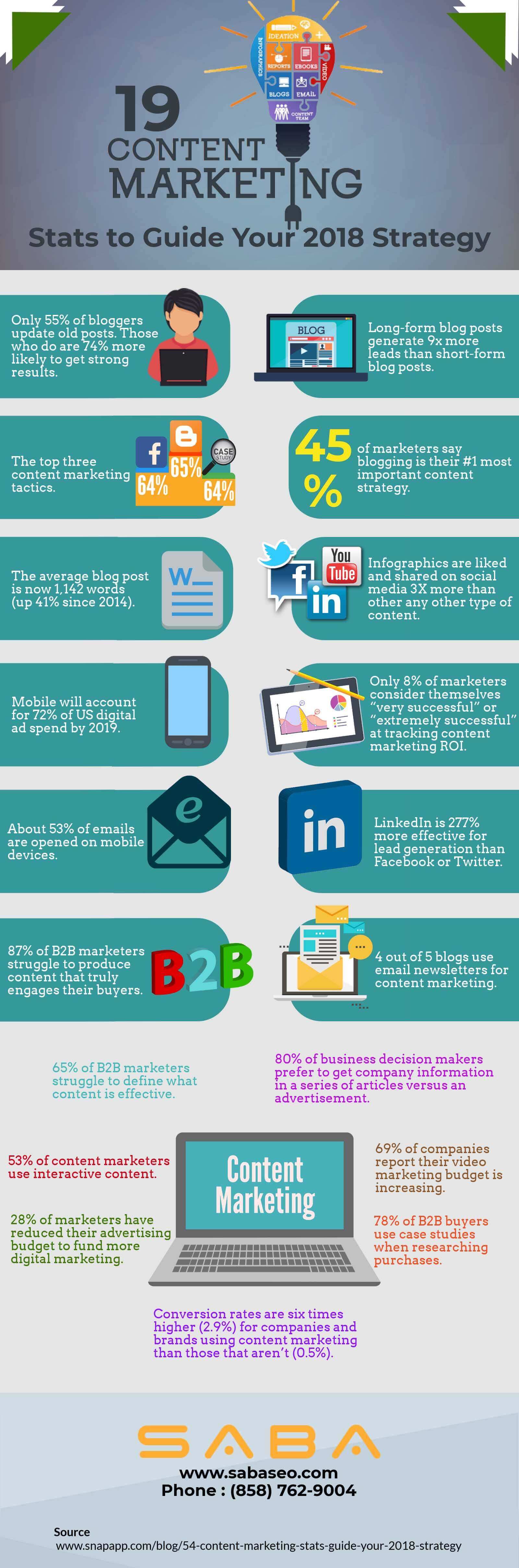
19 Content Marketing Stats to Guide Your 2018 Strategy [Infographic]

If you’re not already using blogs to optimize your business’s website, the time to start is now. There are a variety of reasons content marketing is an effective method of attracting new customers and clients. Saba SEO, a leading provider of internet marketing in San Diego, has put together this handy infographic detailing some of the key statistics that can help you form a content marketing strategy in 2018.

19 Content Marketing Stats to Guide Your 2018 Strategy

3 Simple Ways to Optimize Your Google My Business Listing

Claiming and verifying your Google My Business (GMB) listing is one of the easiest ways to improve your local SEO. GMB-verified businesses are more likely to show up in the Local Pack, Google Maps, and organic rankings. If your business qualifies, you can claim your GMB profile for free and list information like your phone number, address, and business hours.

After claiming and verifying your profile, you can optimize your GMB listing. Optimization will help you reach more potential customers and provide valuable information to searchers. San Diego SEO internet marketing experts at Saba SEO share three tips on optimizing your Google My Business listing.

1. Complete Your Profile Entirely

You should answer all of the questions on GMB when you fill out your profile. The more information you provide, the easier it will be for potential customers to contact you or visit your business. It’s also important to check your profile regularly to make sure the information is still accurate. Anyone can change your information by clicking the “suggest an edit” option on the listing.

2. Use Google Posts

Google Posts are short, small ads that can be included in your GMB profile. You can add photos, links, or a call to action in your post. If you’re having a sale, you can create an event post to advertise. In case you have a new product, you can upload a picture and a link. Google Posts will stay up for a week, so they’re a great way to share current news about your business.

3. Respond to Reviews

Positive reviews can improve your search rankings and increase customer trust. Almost all online searchers read reviews for local businesses before deciding to become customers. You can encourage customers to leave Google reviews and respond to these reviews to show them you care. Respond to positive reviews by showing your appreciation, and reply to negative reviews by sincerely apologizing to the customer and providing contact information so you can discuss the matter offline. Some people just like to leave nasty reviews, but responding to each review professionally can boost your image.

If you want to boost your online ranking, turn to Saba SEO. We offer customized and high-quality search engine optimization services San Diego businesses and companies all over the world can count on. Our experts can devise a comprehensive digital marketing plan for your business, which includes SEO, social media management, PPC, web design and development, and other services. For over ten years, we have helped businesses all over the globe increase their online ranking, attract more customers, and boost their conversion rates. To schedule an appointment with one of our digital marketing experts, call us at 858-951-1717 today.

Request A Free Consultation